
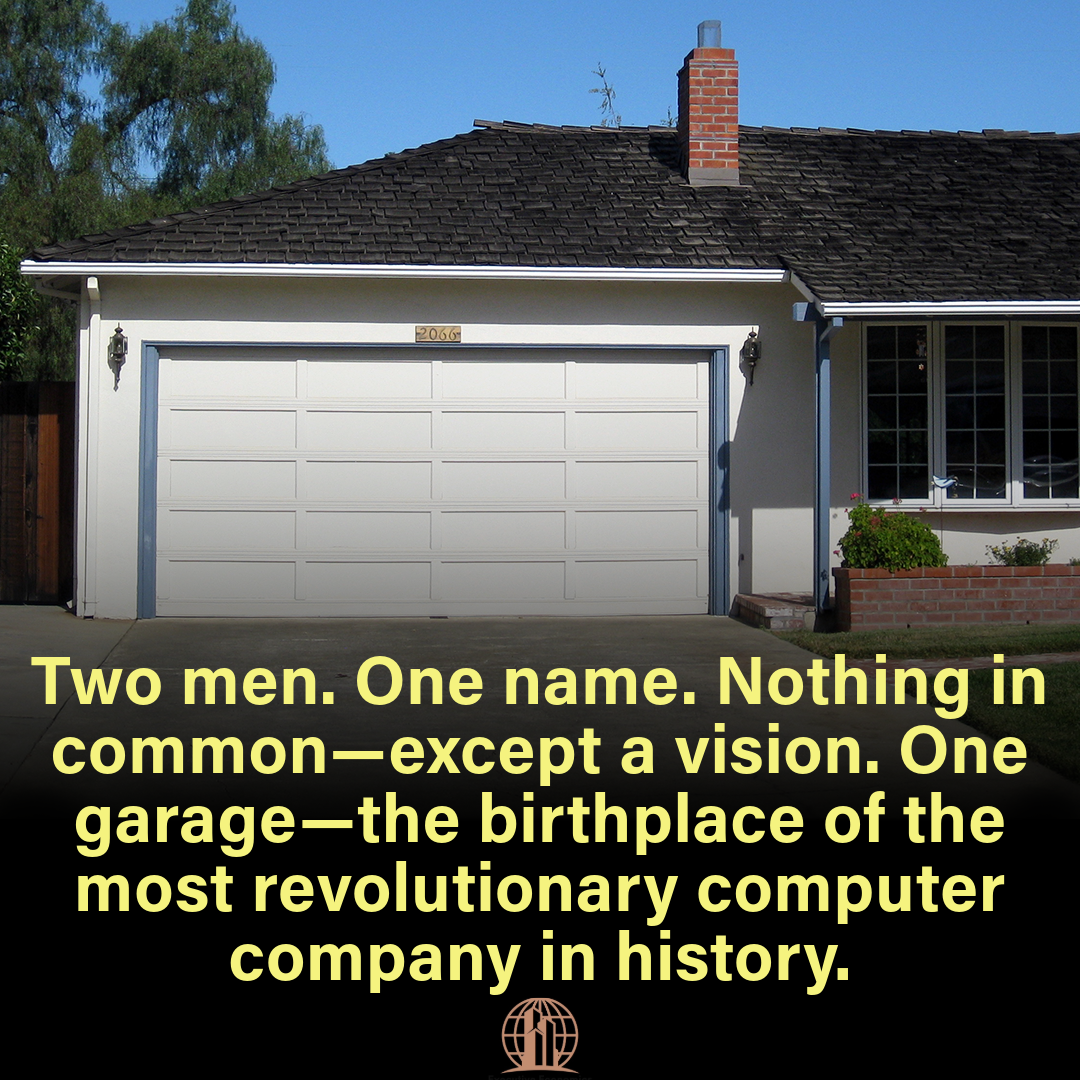
The Original Garage Startup
Every business owner has heard the old cliche – great things start in a garage. Names like Apple and Amazon come to mind, but are their success stories possible to recreate? Let’s explore how Apple became a staple in Forbes’ top 10.
To really understand, you actually have to go back a year before Steve Jobs and Steve Wozniak launched their flagship product Apple I in 1976. Before 1975 computers had limited variations. There were supercomputers, like the original IBM that helped put a man on the moon, these mainframes took up entire rooms, needed teams to run, and handled data processing and calculations. These machines got condensed into minicomputers in the 60s, but they were still complicated machines built for companies.
Home computers were originally seen as a hobby for tech enthusiasts. It was interesting to early computer engineers to be able to build their own circuit board, and program it to do basic math using switches and LED lights. When they successfully taught their computer ‘2+2=4’ it was like solving a puzzle.
The Altair 8800 was a well known DIY computer building kit, it came with the board and the components you needed to build it out; but it was a kit made for hobbyists. You had to glue and solder each tiny piece onto the board, there was no monitor capabilities, the entire computer was based off of switches and flashing lights.
The Apple I came to be when Jobs saw Wozniak’s personal project, a board that had a keyboard component and the ability to plug into any monitor, things the Altair didn’t have. Jobs took that prototype and sold it as a prebuilt board that had never before seen features. Apple Computers positioned themselves as technology for everyone, not just those with specialized knowledge.
While delivering the Apple I, Jobs made promises about the Apple II that he knew they’d need resources to make good on; so he brought in Mike Markkula as their financial backer. He invested $80k for 30% and also provided a $170k credit line to support production of the next gen of Apple Computers. Mike stepped into the administrative role, guiding Apple through incorporation and its IPO. As a retired Intel executive, he brought not only financial resources but also a wealth of experience. His efforts in early marketing were critical to Apple’s success, and he remained an essential part of the company until his departure in 1997.
A year after the Apple I Jobs took his vision even farther, producing the world’s first all-in-one computer package. The Apple Computer went from being just a prebuilt board with interesting capabilities; to a board and keyboard in its own sleek casings, plus it could produce graphics in color. Monitors were sold separate as a way to reduce base cost, the Apple II could still run off a TV monitor anyway.
The Apple II wasn’t just another computer kit, it was a movement. The sleek design and easy to use interface not only made computers more accessible but redefined them as everyday tools for businesses, schools, and homes. With Steve Jobs’ relentless vision, Apple was able to give consumers access to high quality and effective equipment.
This vision paid off in ways no one could have imagined. By the time Apple went public in 1980, it was clear they weren’t just selling computers—they were defining a new market of personal computers. With the IPO raising over $100 million—one of the largest at the time—it wasn’t just a financial milestone; it was a public acknowledgment that Apple had fundamentally reshaped the technology landscape.
Apple’s meteoric rise wasn’t just about building computers—it was about seeing possibilities where others saw limitations. Steve Jobs didn’t simply respond to an existing market; he envisioned how it could evolve. By combining Wozniak’s engineering brilliance with his own obsession for quality and accessibility, Jobs turned the Apple II into more than a product—it was the catalyst for an entirely new market. Apple didn’t just enter the personal computing space; it created it, shaping what the future of technology could look like.
But success brings its own challenges. As Apple grew, the demands of innovation, leadership tensions, and market competition began to test the very vision that defined the company’s rise. What came next was a period of reinvention—both for Apple and for Steve Jobs himself.
Leave a Reply